
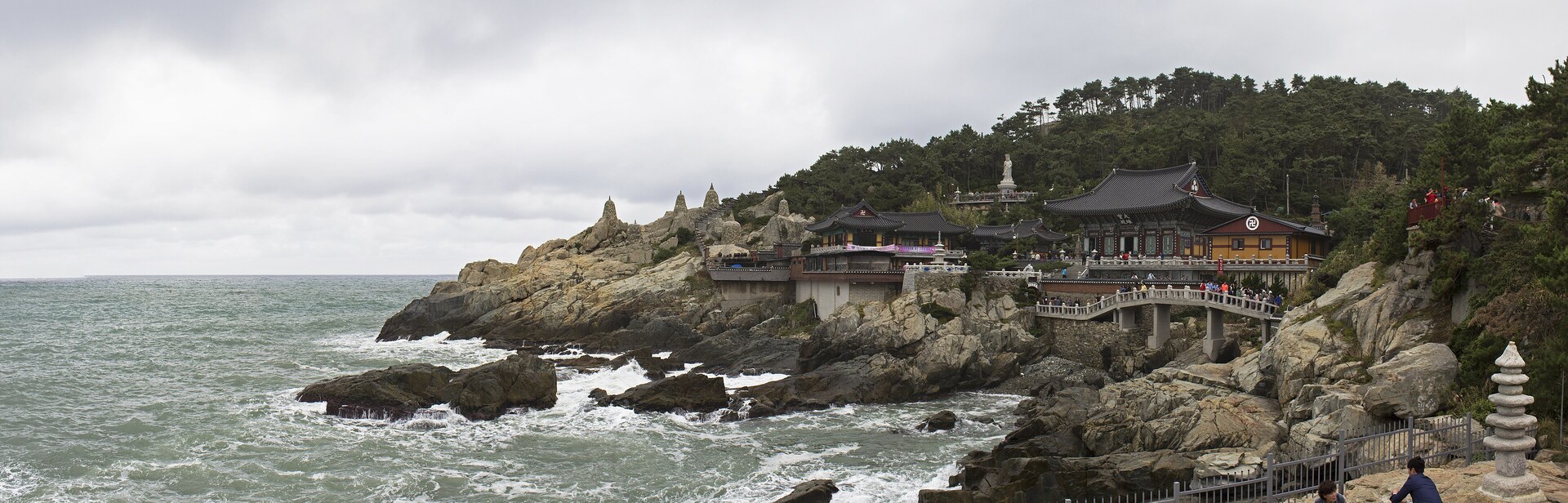
Korean temples are mountain places. You park at the bottom, you climb, and the reward for the climb is silence and a view of more mountains. It is such a fixed pattern that it stops feeling like a choice.
Haedong Yonggungsa breaks it. Here you walk down — 108 steps through a pine grove — and what opens up at the bottom is not a valley but the open sea, close enough to spray the rocks below the shrine halls. It is one of very few Korean temples built at the waterline, and the single reason it appears on almost every Busan itinerary written by someone who has actually been.
A dream, a war, and two hundred empty years
By tradition the temple was founded in 1376 by Naong, a Buddhist teacher who served as royal advisor in the late Goryeo period. The founding story is a dream: a sea god told him to build where the mountain meets the water, and people would be spared hardship. He chose this rock shelf accordingly — mountain at the back, sea at the front.
That date is worth holding loosely. Wikipedia notes the 1376 claim has been disputed, and no one should pretend the paperwork survives from the fourteenth century. What is not disputed is what happened next.
Japanese forces destroyed the complex during the Imjin War in the late sixteenth century, and it was left abandoned for more than two hundred years. Rebuilding only began in the 1930s, led by the monk Ungang. In 1974 the monk Jeongam took over and gave the temple the name it carries now — Haedong Yonggungsa, from a vision of the bodhisattva of compassion rising into the sky on a dragon's back.
So the building you photograph is largely a twentieth-century reconstruction standing on a fourteenth-century idea. That is not a flaw. It is the more interesting fact.
What you are actually looking at
The site is small and stacked vertically, which means the view changes every twenty paces. A few things worth slowing down for:
- The 108 steps. The number is the count of earthly desires in Buddhist teaching. Descending them is the point, not the transit.
- The bridge. You cross water to enter the main precinct — an unusually literal threshold.
- Yongdu-am, the dragon's head rock. A long spur of stone running out into the water beside the temple.
- The main hall, and directly in front of it the open sea, with no valley or forest in between.
- Haesu Gwaneum Daebul, the sea-facing statue of the bodhisattva of mercy, up the slope behind the halls. The climb is short and steep, and the view from beside her is the one people describe afterwards.
Because the temple faces east over open water, it is also one of the few places in Busan where sunrise is the main event rather than a consolation prize.
Getting there, and what it costs
The temple sits at 86 Yonggung-gil, in Gijang-gun — out on the north-eastern coast, well clear of central Busan. Admission is free, and visitors arriving by car pay only for parking.
The temple opens at 4:30 in the morning and closes at 7:20 in the evening, with last entry at 6:50. Those early hours are not decorative. They exist because people come for the sunrise.
Public transport will get you there. Take Busan Metro Line 2 to Haeundae Station and leave by Exit 7, then transfer to bus 181, 100 or Haeundae 9 and ride to the temple stop. From Jangsan Station, the last stop on Line 2, bus 181 also runs to the temple. Plenty of people do it this way and enjoy the ride.
What it costs is the awkwardness of the position. Gijang is not on the way to anything else most visitors have planned. Rome2rio puts the trip from the temple to Gamcheon Culture Village at about an hour and forty minutes by subway, against roughly twenty-six minutes by car. That gap is the whole argument for how you structure a Busan day, and it is why the temple so often ends up as either the first thing you do or the thing you drop.
When to go
Early, if you can stand it. The gates open before dawn, and the difference between the temple at six in the morning and the temple at noon is not subtle.
Around Buddha's Birthday in spring the complex is hung with paper lanterns end to end, and it becomes a genuinely different place — worth planning around if your dates are flexible, and worth knowing about so you are not disappointed to arrive in a month without them.
How we help
Haedong Yonggungsa is on our Busan Highlights full-day route, alongside Gamcheon Culture Village, the Jagalchi and Gukje markets, and the Sky Capsule with Gwangalli after dark. Those four sit in four different corners of the city, which is exactly the problem the timetable creates.
With a private car and a driver who knows the coast road, the temple stops being a commitment you have to build the rest of the day around. You go when the light is right and leave when you are finished, not when a group is called back to a bus. The itinerary is yours to shape, and it is run entirely in English.
Tell us your dates and how much time you have, and we will build the day around what you actually want to see.
Photo: Kramertron, CC BY-SA 4.0, via Wikimedia Commons. Opening hours, address and admission per the Korea Tourism Organization; details can change, so check before an early start.
