
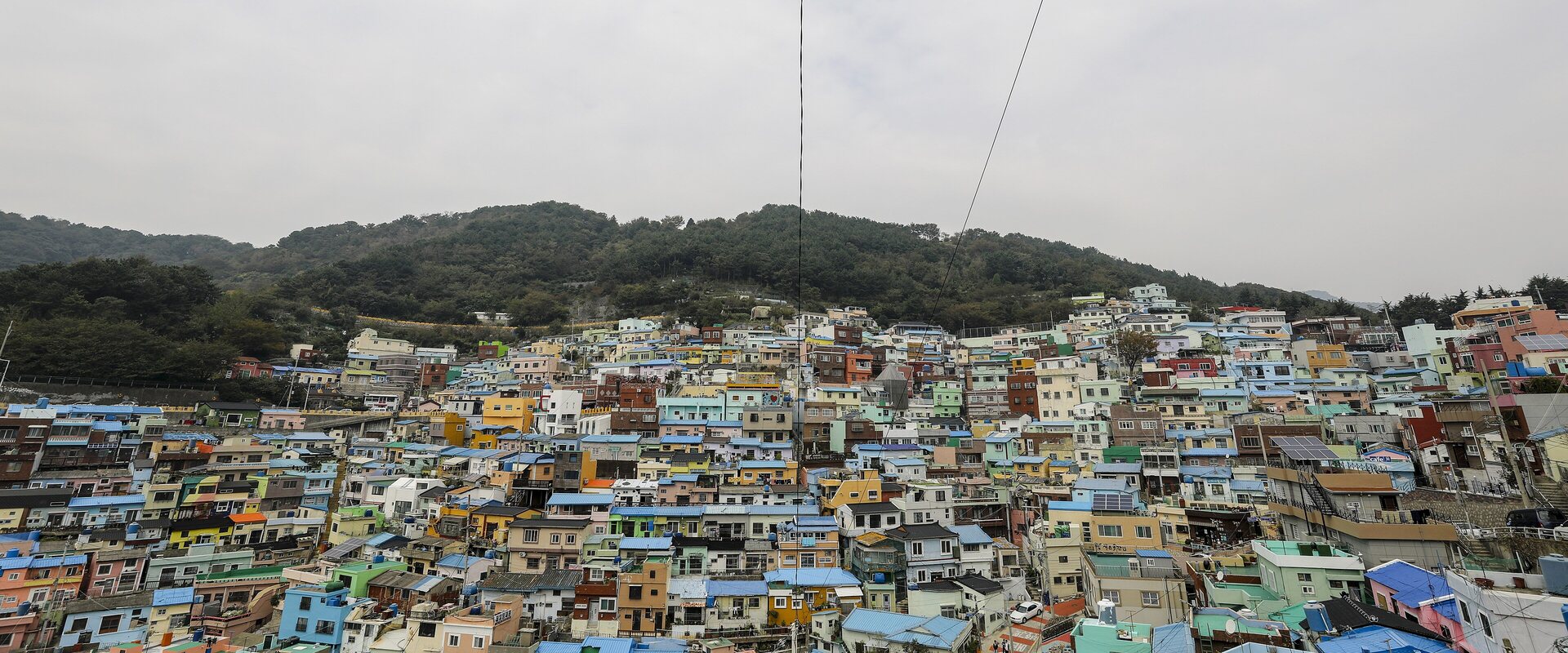
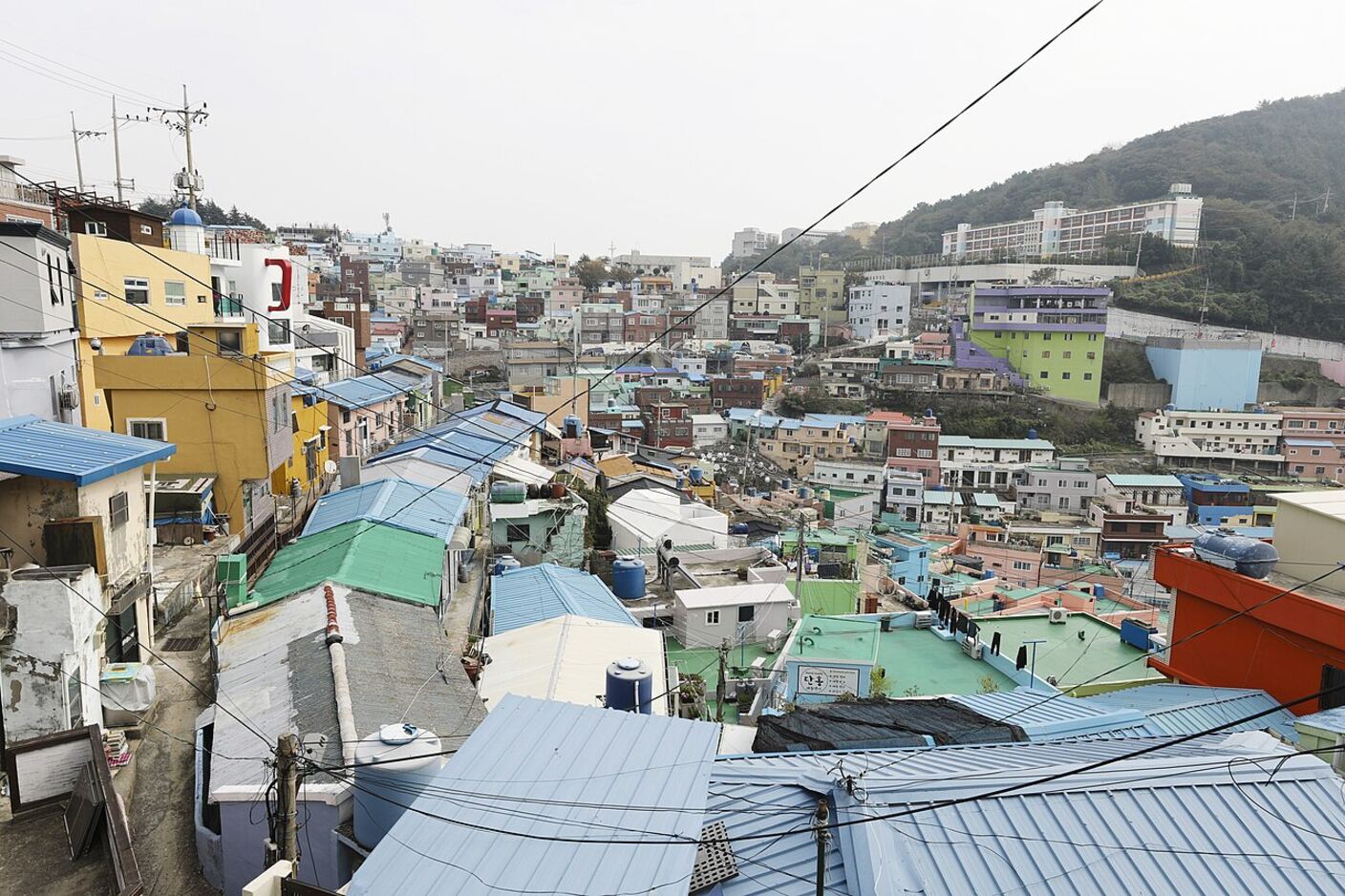
Every photograph of Gamcheon is taken from roughly the same spot, and every caption calls it the Machu Picchu of Korea. The comparison sounds like something that grew up locally over decades, the way nicknames usually do.
It did not. In 2009 the Ministry of Culture, Sports and Tourism ran a competition for village art projects, and the winning proposal for this hillside was titled Dreaming of Busan's Machu Picchu. The nickname is the name of the grant. Which is a good introduction to the place, because almost everything that makes Gamcheon photogenic was a deliberate intervention — and almost everything underneath it was not.
A hillside nobody chose
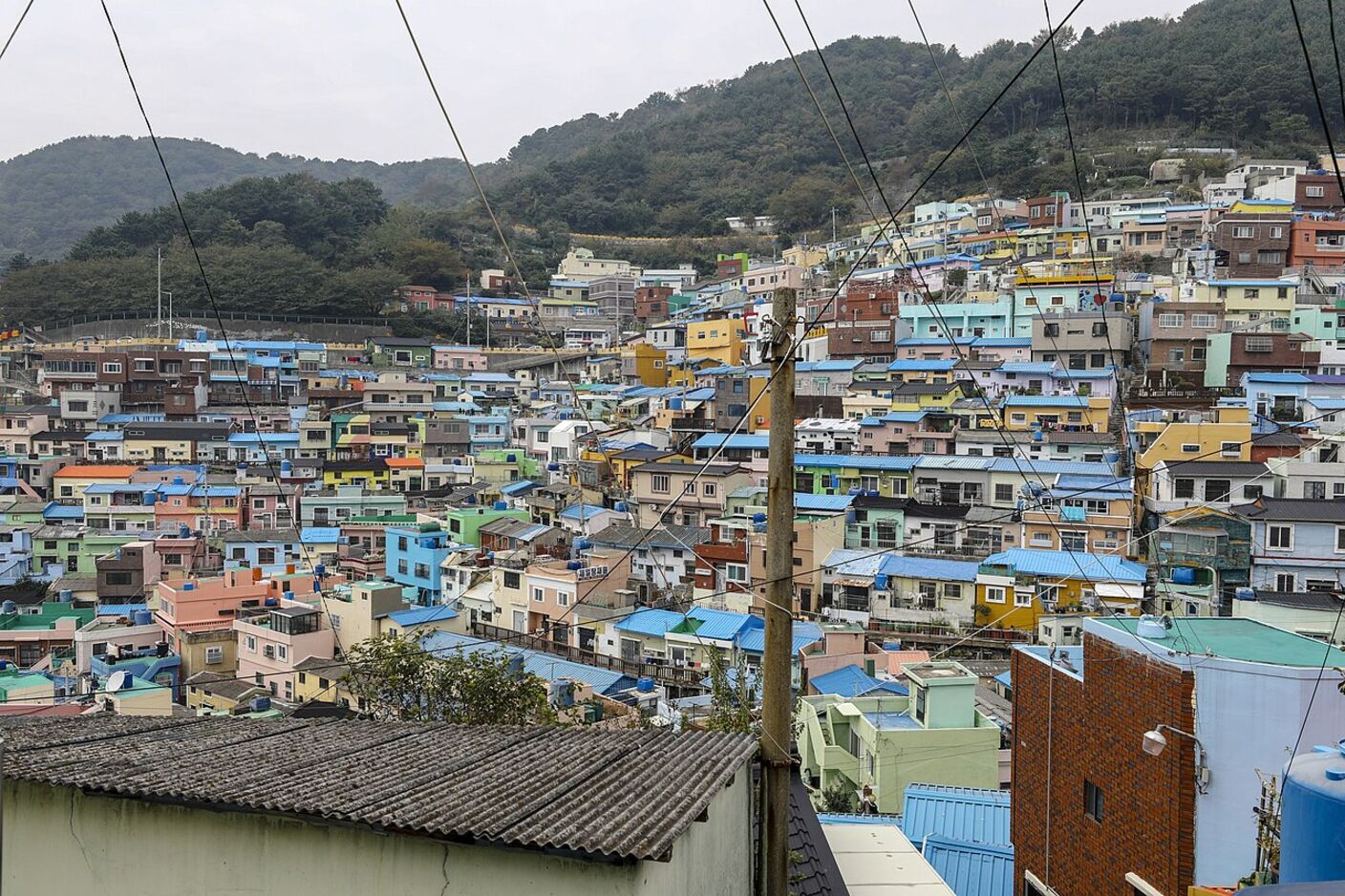
Busan was the provisional capital during the Korean War, and refugees arrived faster than the city could house them. By 1951 there were close to half a million of them on top of an existing population of around 880,000, and people built on whatever ground was left — which meant slopes too steep for anyone to have wanted earlier.
Gamcheon's particular history is stranger than most. In 1955 the city moved some 800 families of Taegeukdo, an ascetic religious community, onto this hillside. They built in stepped rows following the contour, and the pattern that reads today as thoughtful urban design was the practical answer to a slope: stack the houses so that each one keeps its light and its view of the water.
For the next fifty years it was simply a poor neighbourhood on a hill. The paint came in 2009, and again in 2010 with a follow-up alley project. Empty houses — and there were hundreds, as younger residents left — were turned into galleries, cafés and small museums. By 2015 the village was taking well over a million visitors a year.
What you are actually looking at
The famous view is the easy part and takes about four minutes. What the village rewards is going down into it.
- The stepped layout. Once you know the rule — nothing blocks anything behind it — you start seeing it everywhere, and the hillside stops looking random.
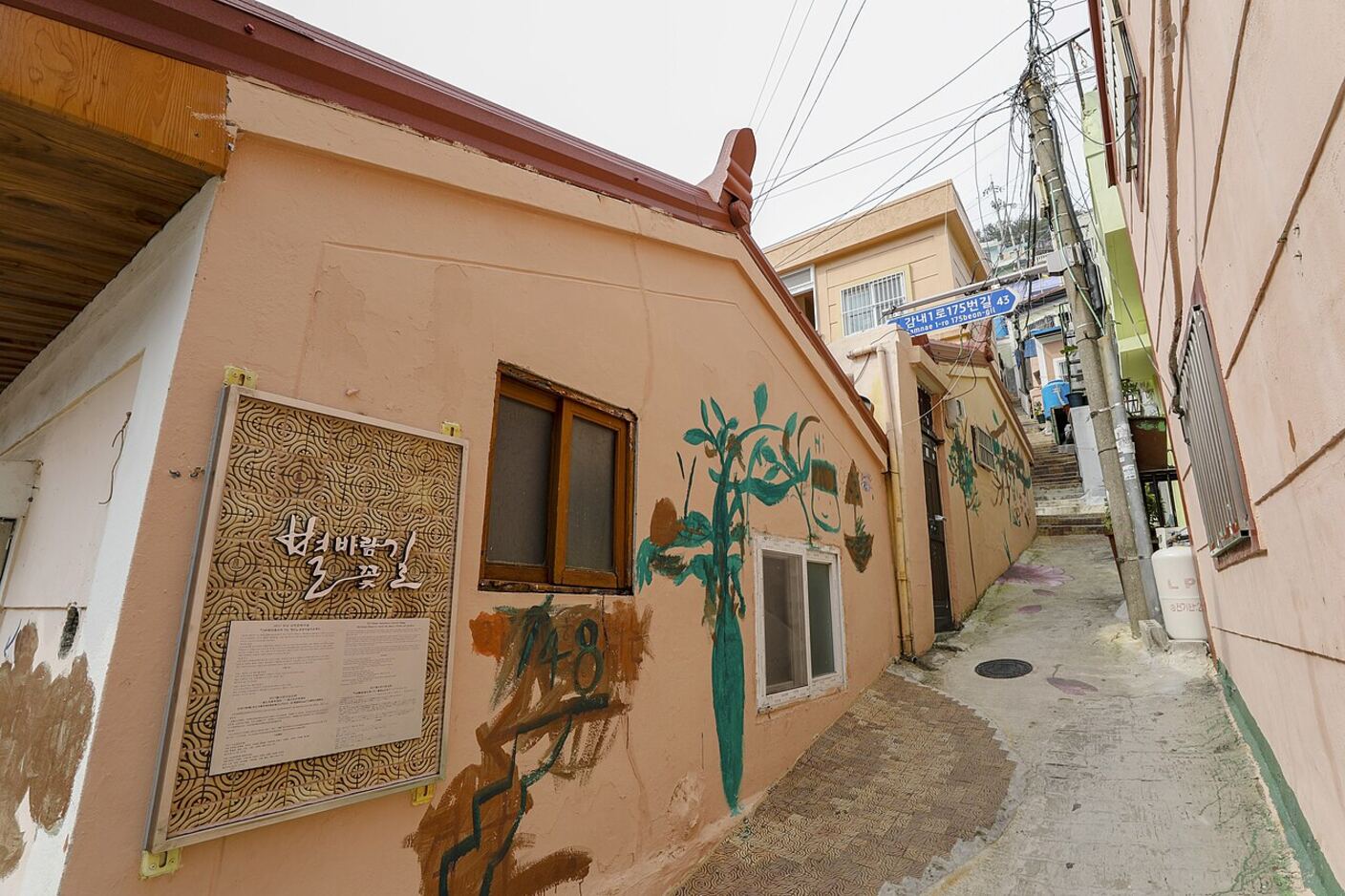
- The alleys. Narrow enough in places for one person at a time, turning back on themselves, opening without warning onto a view of the harbour.
- The art. Murals, sculptures and installations left by the 2009 and 2010 projects, scattered rather than arranged into a trail.
- The stamp map. Sold at the information centre near the entrance, it sends you looking for specific spots and is the single best way to end up somewhere you would not have wandered.
- The ordinary parts. Laundry, parked scooters, a grandmother carrying shopping up a staircase you are out of breath on. This is the part most visitors photograph least and remember longest.
People live here
This is worth saying plainly, because the village does not look like a place anyone lives until you are standing in it. Those are front doors. The staircases are how residents get home with their groceries. Signs throughout the village ask visitors to keep their voices down and stay out of private lanes, and they are not decorative.
Treating it as a neighbourhood rather than a set is also, selfishly, how you get the better visit. Nobody minds a quiet visitor.
Getting there, and what it costs
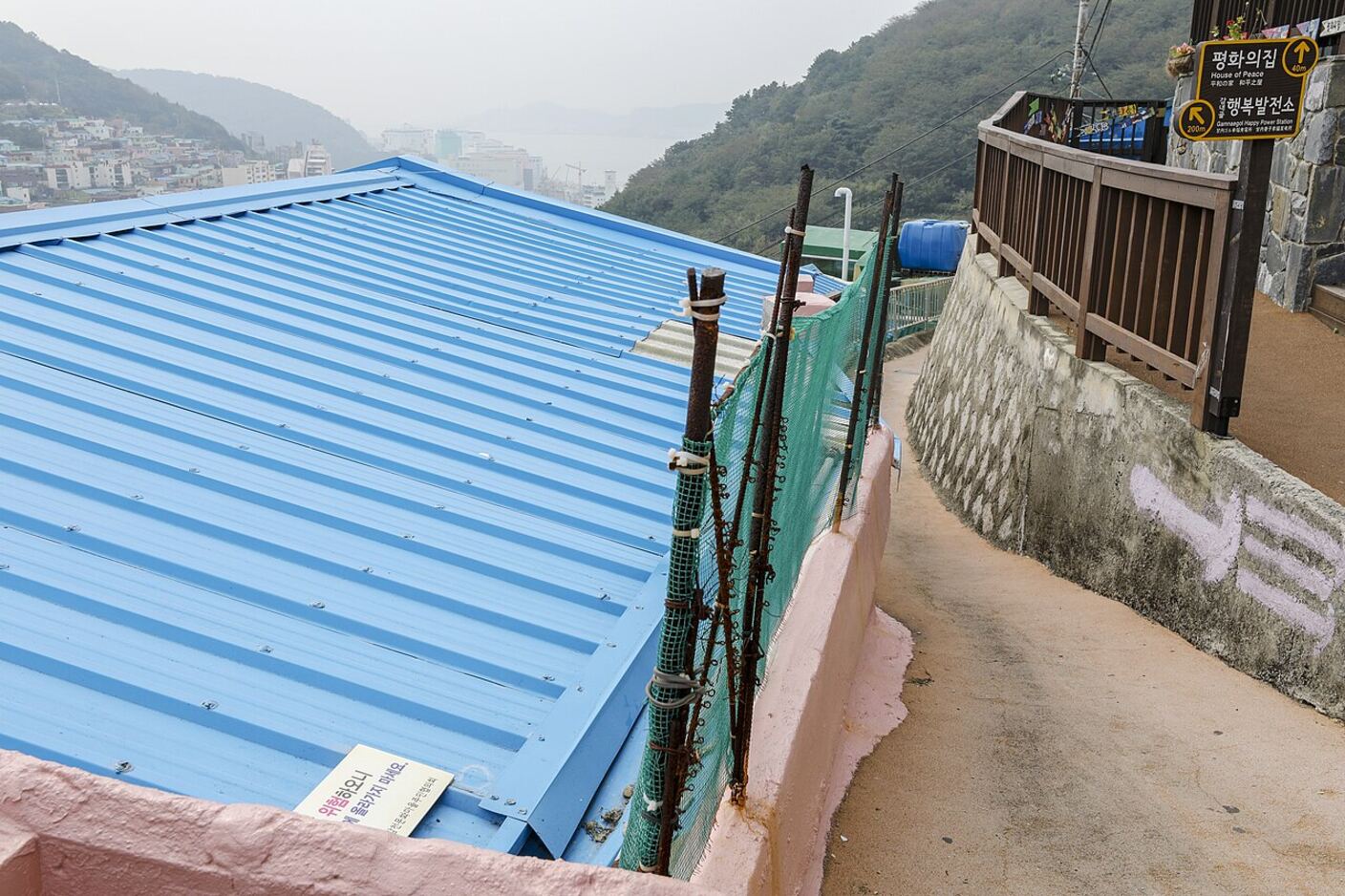
The village sits at 203 Gamnae 2-ro, in Saha-gu, on the western side of the city. The village is a residential neighbourhood and entry is free. The stamp map sold at the information centre is the only thing you need to pay for, and it is optional.
The alleys never close, because people live in them. The tourist information centre runs 09:00 to 18:00 from March to October and 09:00 to 17:00 from November to February.
Public transport gets you most of the way. Take Busan Metro Line 1 to Toseong Station, then transfer to bus 2 or 2-2 for the climb up the hill. The buses are small and fill quickly, because there are not many of them. This is the part of a Gamcheon visit people complain about afterwards, and it is the reason the village is so often the thing that gets cut when a day runs late.
Come prepared to climb. The village is stairs from end to end, and there is no version of it that is flat.
When to go
Early. The alleys are quiet before the coaches arrive, the light comes across the hillside rather than straight down onto it, and the residents get their morning back.
Late afternoon is the other good answer, for the opposite reason — the colour warms up and the harbour below goes gold. The one time to avoid is the middle of a weekend day, when the single main route through the village moves at the pace of the slowest group on it.
How we help
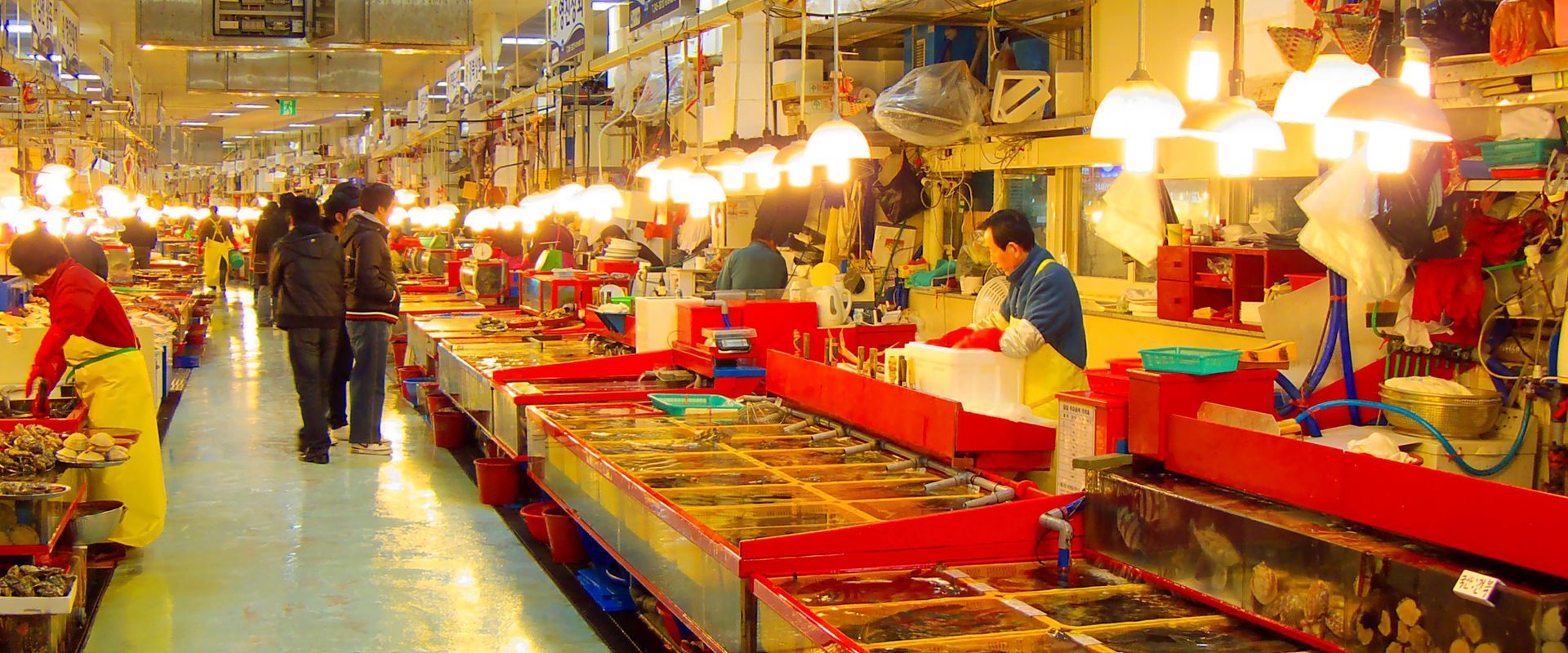
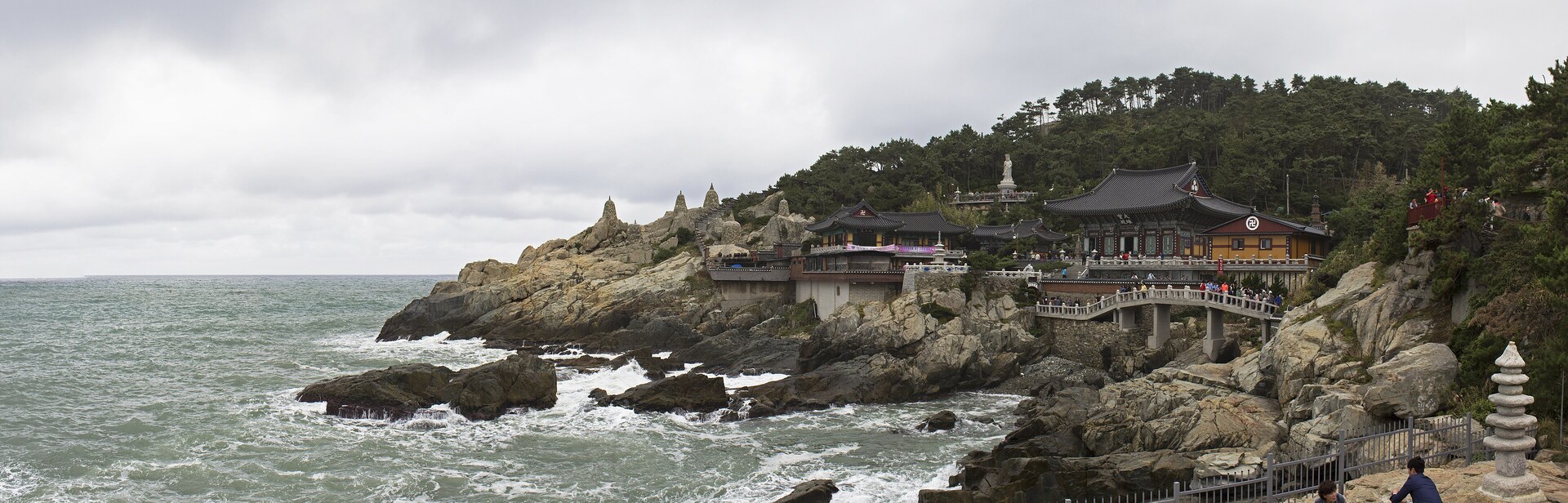
Gamcheon is on our Busan Highlights full-day route, along with the Jagalchi and Gukje markets, Haedong Yonggungsa out on the Gijang coast, and the Sky Capsule with Gwangalli after dark.
The awkwardness is the hill. Gamcheon sits west, the temple sits east, and the connection between them is the part of the day that quietly eats the afternoon. A private car is what turns the hill into something you plan around rather than something that eats the plan: where the walk begins and where it ends are worked out with you beforehand, instead of being decided by where a bus happens to stop, and you leave when you are finished rather than when one is due.
Tell us your dates and how much time you have, and we will build the day around what you actually want to see.
Header photo: bryan…, CC BY-SA 2.0, via Wikimedia Commons. Address, hours and admission per Visit Busan and the Korea Tourism Organization; project history per the Busan History and Culture Encyclopedia. Details can change, so check before you set out.
.jpg)